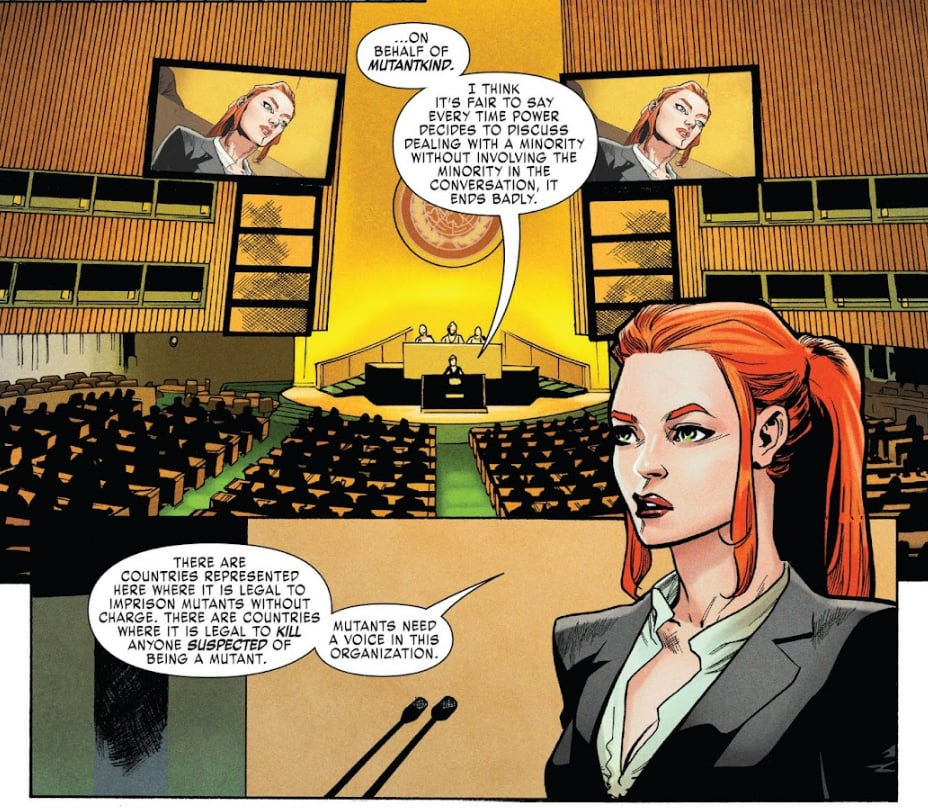
The X-Men is one of Marvel Comics’ longest-running “team books.” The original team consisted of characters like Angel, Beast, Marvel Girl, Iceman, and their leader, Cyclops. The X-men are a group of mutants or “Homo Superior,” a genetic off-shoot of Homo Sapiens. Mutants, unlike heroes like Spider-Man, are born with their powers rather than gaining them through external means. The core of these books are the struggles of mutantkind against the prejudices of humanity. Despite the space faring, sentient island nations, primordial psychic space birds, and the occasional time travel, the core of the X-Men is being a mirror the social justice issues real life marginalized groups experience. The X-Men cast a wide net with how it depicts the social issues of today as applied to real world groups. In 2018, X-Men Red sees a newly revived Jean Grey as she pushes for representation in the United Nation for mutantkind. In her speech, she expressed that “It is fair to say every time power decides to discuss dealing with a minority without involving the minority in the conversation, it ends badly.” This line sets the stage for Jean Grey’s steps towards mutant representation and acceptance. It is also, a very real issue some marginalized groups experience.
In the United States, Asian Americans make up only 6% of the total U.S. population. However, in a population of 340.1 million (as of 2024), 6% is not a small number when put into perspective as that is roughly 20 million people. Despite this, Asians Americans are completely underrepresented in most United States polling data; causing them to be removed from discussions involving policymaking. Although 6% of the population being underrepresented does not in anyway skew any statistic data, it does ignore the very real people behind those numbers and the experiences they live. However, this is only in the mainland United States. U.S. soil is vast and extends in other territories such as Guam in the Pacific and Puerto Rico in the Caribbean.
Puerto Rico has gained some notoriety with American policymakers, with discussions of its possible statehood being on the table. However, its status as being an American territory is often completely overlooked and those from the territory are treated as foreigners despite being Americans. One of the bigger issues plaguing Puerto Rico that gets ignored is its debt crisis that surfaced as a result of government financial mishandling. In 2016, the PROMESA law created a federally appointed fiscal board to help restructure Puerto Rico’s $37 Billion dollar debt. However, was resulted is more of the same mishandling; spearheaded by the fact that the fiscal board are selected by the President and Congress through secretive criterias. PROMESA was a completely unnecessary law as generally, municipalities in the United States are entitled under the Federal Bankruptcy Code to restructure its dets under a Chapter 9 bankruptcy. However, the Federal Bankruptcy Code only grants this ability to municipalities within the United States. This excludes territories like Puerto Rico, causing Puerto Rico to be saddled with debt. In 2015, Puerto Rican lawmakers tried to urge the House of Representatives (and later Senate) to amend the Federal Bankruptcy Code to allow restructuring of debts within territories. But this plea largely fell on deaf ears.
Guam is a small island in the Pacific. It is the United States’ premier military presence in the Asian Pacific region. It is also home to over 167,000 people. Due to the Trump Administration’s gutting of Federal funding, Guam is set to lose over $13 billion in non-defense related funding. This budget cut, along with Guam’s already high cost of living will drive so many of its residents in debt and potentially plunging the island into its own debt crisis. This does not help the fact that Guam is experiencing a shortage in workers and laborers, often resorting to importing workers from surrounding islands like the Commonwealth of the Northern Mariana Islands and the Federated States of Micronesia or even neighboring countries like the Philippines. This sort of labor importation is further complicated by the Trump Administration’s constant attacks against immigration policies; causing the “Island where America’s day begins” to slowly experience its impending blackest night.
American Samoa is undoubtedly one of the territories that are a bit familiar to common folks in the United States; it’s the territory that brought us Dwayne “The Rock” Johnson. It is also the only American territory without birthright citizenship. Under the Fourteenth Amendment, all persons born […] in the United States, and subject to the jurisdiction thereof, are citizens of the United States.” However, American Samoans are considered legally as “non-citizen” nationals or “foreign in a domestic sense.” Thus, those born in American Samoa do not enjoy the same rights and protections that American Citizens enjoy. They are denied the ability to vote, they are denied the opportunity to run for office and represent their communities in lawmaking, and are excluded from holding jobs that require citizenship such as fire fighters, police officers, paramedics, and public school teachers.
The other two United States territories are the aforementioned CMNI and the U.S. Virgin Islands. Like the other three, they are island territories that are experiencing severe economic down turn, lack of representation in Congress, and the rising effects of Climate Change. Generally, these five territories are treated unevenly across the federal statistical system, like Asian Americans in the mainland, the least represented of these territories are often get left out in the discussion for policymaking, provided they are even considered in the first place. And with most of these territories being denied the ability to vote for the powers than they are subjected to, they will likely forever be ignored from the equation as stakeholders and policymaker often only focus on those who can serve as their vehicles to power.
As Jean Grey said, “It is fair to say every time power decides to discuss dealing with a minority without involving the minority in the conversation, it ends badly.” In the X-Men books, this exclusion led to the creation of the Sentinels, powerful mutant-hunting robots that eventually led to the near extinction of the race in the Days of Future Past storyline. Jean Grey also notes in her speech that Mutant nations like Genosha and Utopia were excluded and ignored by the United Nations in their policymaking, which allowed Mutant hate and ignorance to fester globally. In the United States, we see these devastating results of exclusion happen, although not in fantastical sci-fi ways.
For example, the lack of eyes on Asian American struggles led to the rise of Asian American hate during the COVID-19 era, which itself was propagated by disinformation claiming that the disease was engineered in a Chinese laboratory or came from a Chinese man eating a bat. The hate was so rampant that some circles referred to COVID-19 as “Kung Flu,” a racist play on the Chinese martial art of Kung Fu. Many Asian Americans and territory citizens experience being treated as foreign despite being American. This form of ignorance is exceedingly dangerous when juxtaposed with Trump’s initiative to crackdown on suspected undocumented immigrants, an initiative that often acts now and asks questions never to the point of robbing victims of their due process rights. We see Trump trying to attack birthright citizenship by attempting to remove that right from children supposedly born from undocumented immigrant mothers. Not to mention, the economic down turn that the territories are experiencing, which itself is exacerbated by an artificially made inflation through the Jones Act; a law that requires goods transported by water from two U.S. ports be transported on ships that are built, own, and operated by U.S. citizens or permanent residents. This act raises the cost of shipment of goods from the mainland to the territories, leaving the residents to cover the cost of shipment.
Policymakers in general need to be mindful of all people affected by their decisions, not only those with the power to vote. Especially when the inability to vote and run for office are artificially placed in the text of the law that will never ever be removed due to fears of a drastic shift in the U.S.’s political paradigm.


 The Timely Planet
Leave a comment