What does it mean to be a hero? What makes a legacy? Is your legacy, your perception, a combination of every act you’ve ever done in life? Or can one mistake tarnish a legacy forever?
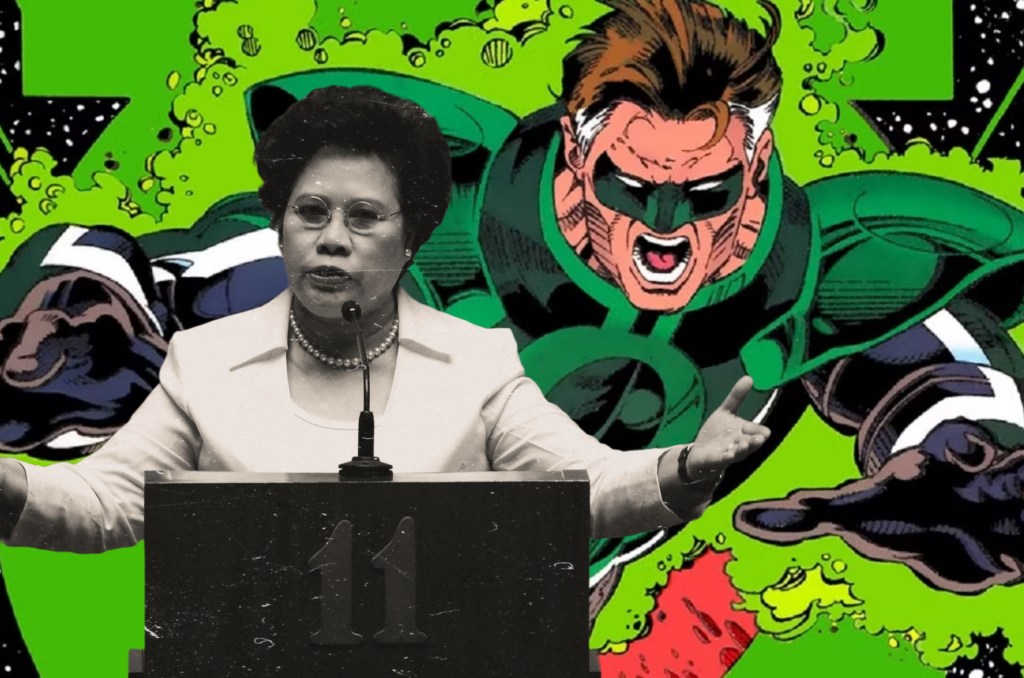
Miriam Defensor Santiago is a Filipino lawyer, a former judge, a former lawmaker, and most importantly for this essay, a former presidential candidate. For most of her life, Miriam Santiago was a non-conformist. She dared to challenge everyday notions of society, and made a career of it. Her championing of democracy and the rule of law, and her ardent criticism of corrupt politicians earned her the nickname in some circles as “The best president [the Philippines] never had.” Despite her passing in 2016, her name remains ever present in the zeitgeist, especially when controversy arises in the Philippine government. She was intelligent, she was courageous, and she fought for the rights, interests, and liberties of the Filipino people. By all accounts, Miriam Defensor Santiago left a legacy many could only dream of. However, her legacy was tarnished by one of the biggest blights recent Philippine history; running in the 2016 Presidential election with the son of the Philippines’ former dictator as her vice president.
Ferdinand “Bongbong” Marcos Jr. (“Bongbong”) is the son of former dictator Ferdinand Marcos Sr. (“Marcos”). Marcos’ 21-year rule over the Philippines was one of the darkest, bloodiest, periods in the country’s history. Marcos’ brutal dictatorship allowed police officers and military personnel to detain, torture, and rape citizens without due process of law. His political enemies and critics were detained, deported, and even killed, such as the case with Senator Benigno “Ninoy” Aquino. His family and cohorts benefitted from his rule, robbing the country blind to fuel their cartoonishly lavish lifestyles. Bongbong, for example, as the young prince of the Marcos dictatorship was given his own private safari in Palawan. Eventually, the dictatorship was put to a stop by the EDSA People Power Revolution. The revolution named Corazon “Cory” Aquino as the new president of the Philippines. A new, brightest day, in the Philippines began to dawn. Eventually, the Marcos family ran to Hawaii. And although the Philippines from 1981 to 2016 faced its fair shares of hardships, the Marcos dictatorship began to feel like a distant memory to many. Perhaps, for the worst, as in 2016, the bastion of democracy, Miriam Defensor Santiago not only defended Bongbong. But also ran with him as her vice president.
“I was correct [with my decisions]. The truth will always be the truth. Justice will always be justice… Life doesn’t have to be a constant straight line from one end to another,” Santiago told reporters at the Commission on Elections headquarters in Intramuros, Manila.
“Times change. Your ideologies are different from those of your parents. We always have to adjust with the times,” she added.
Shortly after losing the 2016 election to Rodrigo Roa Duterte, Miriam Defensor Santiago passed away, succumbing to her lung cancer. She left a legacy of good governance, an ardent defense of democracy, and being the champion of the people. But she also left another legacy as Bongbong would use the platform given to him by the 2016 election to undermine the winning vice president, Leni Robredo’s, legitimacy to the vice presidential seat. Using an army of trolls to peddle disinformation with the aim of villainizing Leni Robredo, villainizing the Aquino family, and revising the history of the Martial Law era, Bongbong was eventually able to take the presidency in 2022. Finally regaining the power his family was long ousted from. However, this is not about Bongbong, this is about Miriam Defensor Santiago. Does running with Bongbong somehow affect her legacy?
One shining moment does not redeem Parallax for what he did or tried to do.
– Batman, The Final Night (1996)
Hal Jordan is a comic book character from DC Comics. He is a test pilot who was later chosen by a cosmically powered green ring for his ability to “overcome great fear,” turning him from an ordinary test pilot into a Green Lantern, perhaps even the Green Lantern. As a Green Lantern, Hal Jordan protected space sector 2814, the sector where Earth resides, from all sorts of threats both cosmic and terranian. However, in Green Lantern issue #48 from 1993, after his hometown of Coast City was destroyed, Hal Jordan was grief-stricken. His green ring that can make any construct, limited only by the imaginations of its wielder, was used to recreate his entire hometown from memory. This was a testament to both Hal’s willpower, which powered the ring, and Hal’s desire to bring back everything he had lost. However, he would be scolded by one of the Guardians of Oa, being told that his use of the ring for personal gain was a violation of the Green Lantern code. Fueled with rage, grief, and desperation, Hal Jordan flies back into the Green Lantern homeworld of Oa. Slaughtering his former teammates, commandeering their rings, and eventually absorbing the green light of will into himself, becoming the villain known as “Parallax.”
However, Hal Jordan would not stay a villain for long as in 1996’s The Final Night, he is persuaded by the last Green Lantern, Kyle Rayner, into reigniting the Earth’s dying sun. Saving multiple lives in the process. In its epilogue, the forever optimist Superman claims that Hal had finally been redeemed in his final act of sacrifice. Batman, the pragmatist, tells Superman “not to make a martyr out of a murderer.” Batman and Superman’s short dialog asks a question that many of us ask in our every day life, especially in the era of “Cancel Culture.” What makes a legacy? Can one mistake, no matter how grave, forever change a person’s legacy? Or is a legacy the collection of every action the person has done in their lives?
Hal Jordan returned to become the Specter, God’s spirit of vengeance in an otherwise impure world. Eventually in 2004, Hal Jordan returns to life as a Green Lantern in Geoff John’s Green Lantern Rebirth. However, in real life, people don’t get that sort of second chance. We have one life and that’s it. There was no way for Miriam Defensor Santiago to foresee what Bongbong could have done after the election. Even if she could, she was battling lung cancer and had to understandably put her own health above all else. The issue with talks of legacy, especially one like Miriam Defensor Santiago’s is that we treat these very real people as characters. Miriam Defensor Santiago is human, despite what her accomplishments may show, she is still flawed and capable of mistakes. The notion of her being the “best president the Philippines never had” is founded in the deifying of her, turning her into more than what she is, based on her past actions and wishful what-ifs that may never come. A person’s legacy should not be seen as an absolute. But rather as a tapestry, patchworks of different acts, intent, accomplishments, failures, and mistakes — full of blackest nights, brightest days, and emerald twilights. No one person can ever be truly infallible.

 The Timely Planet
Leave a comment